

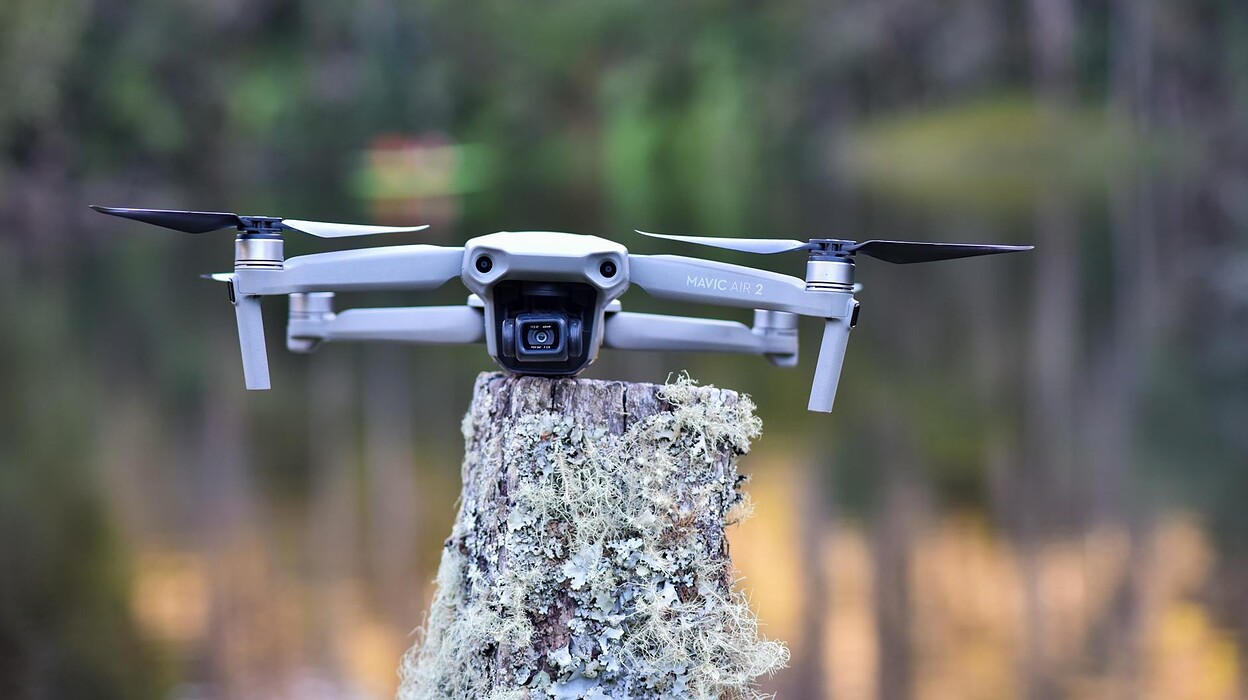
The question “how do drones work” opens a fascinating exploration of aerospace engineering, computer science, and robotics converging in devices that fit inside a backpack. While consumer drones appear deceptively simple press a button and they hover magically the underlying technology represents decades of advancement in sensor fusion, control theory, and artificial intelligence. This guide explains the complete technical stack powering modern unmanned aerial vehicles, from propeller physics to AI decision-making, in accessible terms that don’t require an engineering degree to understand.
Flight Mechanics: Defying Gravity with Precision
At the most fundamental level, drones work by generating thrust through rapidly spinning propellers that push air downward, creating an equal and opposite reaction that lifts the aircraft upward. Multirotor drones the most common configuration for consumer and commercial use typically employ four, six, or eight propellers arranged symmetrically around a central body.
The magic of controlled flight lies in variable motor speeds. To hover, all propellers spin at identical speeds, creating balanced upward thrust. To pitch forward, the rear motors spin faster than the front motors, tilting the aircraft and directing some thrust horizontally. Roll (tilting left or right) and yaw (rotating around the vertical axis) operate through similar differential speed adjustments. A flight controller a specialized computer processing inputs hundreds of times per second calculates the precise motor speeds needed to achieve the pilot’s desired movement while compensating for wind, payload weight, and battery voltage fluctuations.
Modern flight controllers in 2026 utilize advanced algorithms that predict rather than merely react. Model predictive control (MPC) anticipates how the drone will respond to motor changes over the next several seconds, enabling smoother footage and more aggressive maneuvering without instability. This technology, derived from autonomous vehicle research, distinguishes premium drones from budget alternatives that use simpler proportional-integral-derivative (PID) controllers.
Sensor Fusion: Knowing Where You Are
Understanding how do drones work requires examining their sensory systems arguably more complex than the propulsion mechanism. A typical consumer drone in 2026 carries a dozen or more sensors that continuously feed data to the flight controller.
GPS and GLONASS satellite receivers provide absolute position data, enabling features like return-to-home and waypoint navigation. However, GPS accuracy varies between 3-10 meters under ideal conditions unacceptable for precision hovering or indoor flight. Therefore, drones supplement satellite data with downward-facing cameras and ultrasonic sensors that track surface texture and distance, enabling position hold accurate to within centimeters even without GPS.
Inertial Measurement Units (IMUs) combine accelerometers and gyroscopes to detect orientation changes and acceleration forces. These sensors operate at 1000Hz (one thousand readings per second), providing the immediate feedback necessary for stability correction. Magnetometers (digital compasses) determine heading, though they require calibration away from metallic interference.
The 2026 advancement in sensor fusion is visual-inertial odometry (VIO) using camera feeds and IMU data together to track position in GPS-denied environments. This enables reliable indoor flight, tunnel inspection, and urban canyon navigation where satellite signals degrade.
Communication Systems: The Invisible Tether
Drones communicate with ground controllers through radio frequency (RF) links operating in the 2.4GHz or 5.8GHz bands the same frequencies used by Wi-Fi but with specialized protocols optimized for low latency and interference resistance. DJI’s O4 transmission system, current industry standard, achieves ranges exceeding 20 kilometers in unobstructed environments with 1080p video feeds.
The communication link carries two distinct data streams: command and control (C2) signals from pilot to drone, and telemetry/video downlink from drone to pilot. Both streams employ frequency-hopping spread spectrum technology that rapidly switches channels to avoid interference. Encryption prevents signal hijacking a critical security feature for commercial operations.
Cellular connectivity has expanded drone communication capabilities in 2026. Drones equipped with 4G/5G modules can operate beyond visual line of sight (BVLOS), transmitting data through cellular towers rather than direct radio links. This enables drone-in-a-box operations where aircraft launch, execute missions, and return autonomously from remote command centers hundreds of kilometers away.
Camera Stabilization: Eliminating Vibration
Aerial photography demands eliminating the high-frequency vibrations inherent in multirotor flight. Gimbals motorized stabilization platforms isolate the camera from aircraft movement using brushless motors that counteract pitch, roll, and yaw in real-time.
Three-axis gimbals represent the current standard, with each axis controlled by a dedicated motor responding to IMU data at 400Hz or faster. Advanced algorithms distinguish between intentional aircraft movement (pilot commands) and unwanted vibration (propeller imbalance, wind gusts), stabilizing only the latter to maintain framing intent.
Camera technology has similarly advanced. The best drones for beginners 2026 and professional models alike utilize 1-inch or larger sensors that capture more light than the smartphone-sized sensors of early drones. Mechanical shutters eliminate rolling shutter distortion during fast movement, while variable apertures adapt to changing light conditions without ND filter changes.
AI and Autonomy: The Pilot’s Digital Co-Pilot
Perhaps the most transformative element in how do drones work is artificial intelligence. Computer vision systems process camera feeds to identify and track subjects, detect obstacles, and plan collision-free paths.
Neural networks trained on millions of flight hours enable obstacle avoidance that understands object categories not just “there is an obstacle” but “that is a tree, that is a building, that is a person.” This semantic understanding allows drones to predict obstacle movement and plan avoidance maneujectories accordingly.
ActiveTrack and similar subject tracking systems use simultaneous localization and mapping (SLAM) to maintain subject lock while building 3D environment maps. The drone doesn’t just follow a visual target; it understands the spatial relationship between itself, the subject, and surrounding obstacles, enabling complex tracking shots through forests or around buildings that would challenge expert pilots.
In 2026, AI has expanded to mission planning. Operators define objectives “inspect this solar farm for hot spots” and AI systems autonomously plan optimal flight paths, camera angles, and data capture patterns. Human oversight remains mandatory for safety, but the cognitive load of mission execution shifts increasingly to machine intelligence.
Power Systems: The Battery Bottleneck
Despite all technological advances, battery chemistry remains the primary constraint on drone capability. Lithium-polymer (LiPo) batteries power most drones, offering energy density around 200-250 Watt-hours per kilogram. A typical consumer drone carries a 3000-5000mAh battery providing 25-45 minutes of flight time depending on conditions.
Battery management systems (BMS) monitor cell voltage, temperature, and discharge rates to prevent dangerous failures while maximizing usable capacity. Smart batteries communicate with the drone to predict remaining flight time based on current power draw, adjusting estimates in real-time as wind conditions or payload weight changes.
Emerging solid-state battery technology promises 50% energy density improvements, but commercial availability for drones remains limited in 2026. Until then, operational planning must account for frequent battery swaps or tethered power solutions for extended missions.
Conclusion
Understanding how do drones work reveals a remarkable integration of mechanical engineering, sensor technology, communication systems, and artificial intelligence. What appears as simple remote-controlled flight actually involves thousands of calculations per second across multiple interconnected systems. As AI autonomy advances and battery technology improves, the boundary between piloted and autonomous operation continues blurring. For operators and businesses leveraging drone technology, this technical foundation informs better purchasing decisions, safer operations, and more effective integration of aerial capabilities into broader workflows.


