

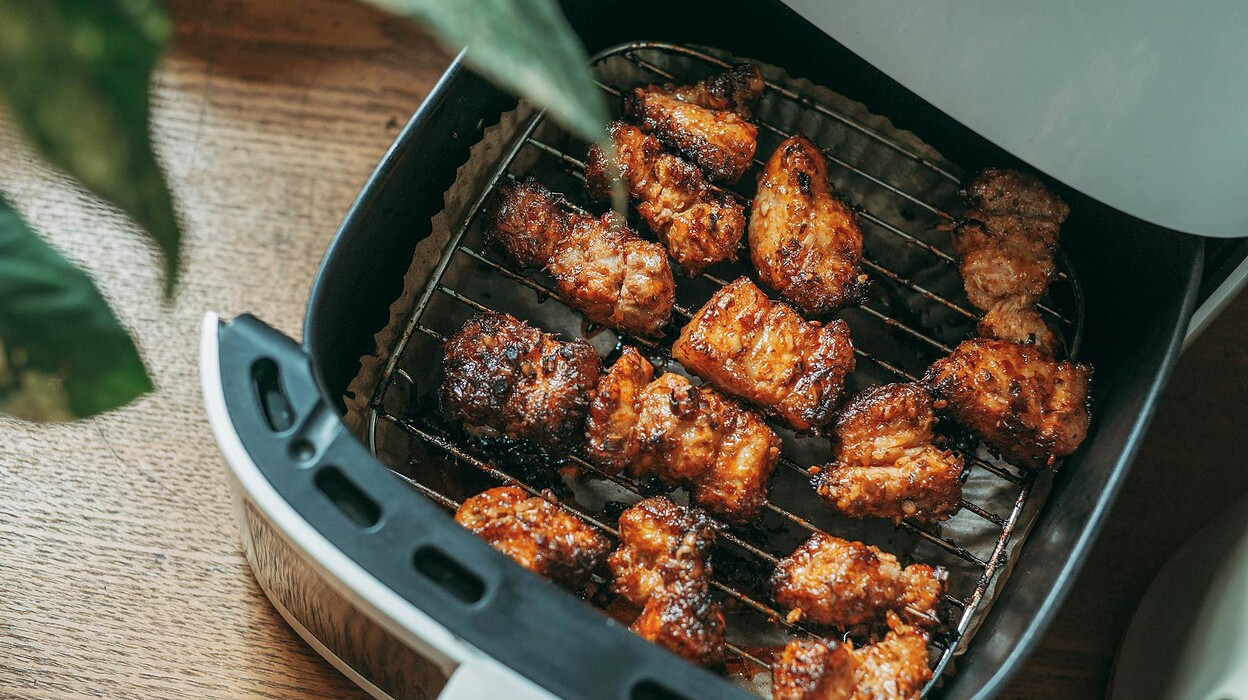
The kitchen appliance that promised to replace deep frying has itself been replaced—intellectually, at least—by a new generation that claims to think. AI air fryers, integrate cameras, sensors, and machine learning to automate the cooking decisions humans previously made through guesswork and recipe following. But does the artificial intelligence actually improve outcomes, or is it premium pricing for marginal convenience? This 2026 evaluation examines the technology, leading models, performance comparisons, and whether smart algorithms justify the smart appliance investment.
What Makes an Air Fryer “AI”?
Traditional air fryers operate simply: heating element, fan, timer, temperature control. Users input parameters based on recipes or experience, and the machine executes blindly regardless of what’s actually happening inside the chamber.
AI air fryers add perception and adaptation. Internal cameras identify food type, quantity, and surface browning. Temperature and humidity sensors track moisture loss and Maillard reaction progression. Weight sensors detect food mass and cooking rate. Machine learning models trained on thousands of cooking cycles predict optimal timing and temperature adjustments for specific outcomes.
The “intelligence” manifests in several operational differences:
Automatic Recognition: Place chicken thighs in the basket, and the AI identifies the protein, estimates weight, and selects appropriate cooking parameters without user input. No recipe consultation, no temperature guessing, no “is it done?” anxiety.
Real-Time Adjustment: Mid-cook camera analysis detects uneven browning; the AI adjusts fan speed and heating element distribution to correct hot spots. Moisture sensors detect drying before food becomes overcooked; temperature automatically reduces to finishing mode.
Outcome Optimization: Users select preferences—”extra crispy,” “juicy center,” “well-done”—and the AI modulates parameters to achieve these specific textures rather than uniform cooking. The same chicken thighs can be prepared with different internal targets based on user preference.
Learning and Adaptation: Some models track user feedback (“too dry,” “perfect”) and adjust future cooking of similar items. This personalization layer improves outcomes over time for individual households.
Leading AI Air Fryer Platforms in 2026
The smart air fryer market has stratified into several distinct approaches:
COSORI Dual Blaze AI integrates dual heating elements (top and bottom) with camera-based food recognition and automatic parameter selection. The AI adjusts for fresh vs. frozen states, and the companion app provides post-cook analysis with photos and timing breakdowns. At $180-$220, it represents moderate premium over basic models.
Ninja Foodi Smart XL emphasizes sensor density—temperature, humidity, and weight sensors without camera integration. The AI focuses on moisture management and crispness optimization through environmental sensing rather than visual analysis. The 10-quart capacity suits families, and the $200-$250 price includes multi-function pressure cooking capability.
Tefal ActiFry AI Vision incorporates the most sophisticated camera system, with top-down and side-view lenses capturing browning progression from multiple angles. The AI generates time-lapse cooking videos shareable through the app—a social media feature targeting content creators. European-market focus with limited US availability.
CHEF iQ Smart Air Fryer leverages app integration for recipe-guided cooking with AI parameter adjustment. The intelligence is distributed—cloud-based models process camera feeds with more computational power than on-device chips allow. Requires consistent Wi-Fi but enables more sophisticated analysis. At $150-$190, it undercuts camera-equipped competitors.
Instant Pot Vortex AI combines Instant Pot’s brand trust with basic AI features—primarily food recognition and automatic timing. The “AI” is less sophisticated than premium competitors but provides genuine convenience at $120-$150, approaching traditional air fryer pricing.
Performance Comparison: AI vs Traditional
Objective evaluation requires comparing outcomes across consistent criteria:
Consistency: AI air fryers reduce outcome variability between users. A novice following manual instructions may undercook or overcook; the AI’s perception and adjustment produces more reliable results across skill levels. However, experienced cooks with developed intuition often match or exceed AI outcomes through manual optimization.
Texture Optimization: The AI’s ability to target specific textures—crispy exterior, juicy interior—represents genuine advancement. Traditional air fryers apply uniform heat; users achieve texture variation through technique (shaking, flipping, temperature modification) that AI automates. Side-by-side testing shows AI models achieving superior texture targets 70-80% of the time for novice users.
Energy Efficiency: AI optimization reduces cooking time and temperature precision, yielding 10-15% energy savings compared to conservative manual settings. Over years of use, this efficiency partially offsets premium pricing, though the payback period remains lengthy.
Failure Modes: AI air fryers introduce new failure types. Camera misidentification (mistaking fish for chicken) produces inappropriate parameters. Connectivity-dependent models fail when Wi-Fi is unavailable. Software bugs require updates. Traditional models fail only through mechanical malfunction—simpler to diagnose and repair.
Food Versatility: Current AI excels at common items: proteins, vegetables, frozen foods. Unusual preparations—dehydrating, baking, multi-component meals—may confuse recognition systems. Traditional models with manual control accommodate creative cooking that AI constraints limit.
The Algorithm Reality: What’s Actually Happening
Marketing “AI” obscures varied technical implementations. Understanding actual algorithm functions clarifies value assessment:
Rule-Based Systems: Many “AI” air fryers use decision trees—if food is chicken and weight is X, then temperature Y for time Z. These are expert systems, not machine learning, but still provide useful automation.
Computer Vision: Camera-equipped models use convolutional neural networks trained on food image datasets. Recognition accuracy exceeds 95% for common items but degrades with unusual preparations, heavy seasoning altering appearance, or multiple food types combined.
Sensor Fusion: Advanced models combine camera data with temperature, humidity, and weight sensors through probabilistic models that estimate internal doneness without direct measurement. This approximates the multi-sensory judgment experienced cooks employ.
Reinforcement Learning: The most sophisticated systems incorporate user feedback to improve future performance. However, learning requires consistent use and feedback—benefits accumulate slowly and may never materialize for sporadic users.
Cost-Benefit Analysis
AI air fryers command $40-$100 premiums over equivalent-capacity traditional models. Value assessment depends on user profiles:
High-Value Users: Cooking novices seeking reliable results without skill development; busy professionals valuing convenience over cost; tech enthusiasts appreciating gadget integration; households with variable cooks (teenagers, elderly) who benefit from automated guidance.
Low-Value Users: Experienced cooks with established techniques; budget-conscious buyers prioritizing function over features; minimalists averse to app dependencies; those primarily reheating frozen foods where AI advantages are minimal.
The break-even calculation: if AI convenience saves 10 minutes per use through reduced monitoring and guesswork, and you use the air fryer 4 times weekly, that’s 35 hours annually. At $15/hour implied value of time, the premium pays back within months for frequent users. For occasional users, the math favors traditional models.
Integration and Ecosystem Considerations
AI air fryers increasingly connect with broader smart kitchen ecosystems:
Recipe Platforms: Integration with Tasty, Allrecipes, and proprietary platforms enables one-tap cooking where the AI automatically implements recipe parameters. This reduces the “recipe says 400°F for 20 minutes but my air fryer runs hot” calibration problem.
Meal Planning: Some models suggest cooking sequences based on refrigerator inventory scanned through companion apps. The AI air fryer becomes one component of integrated meal preparation rather than isolated appliance.
Health Tracking: Calorie estimation, macronutrient breakdown, and cooking method logging integrate with fitness platforms. For users tracking nutrition precisely, this automation reduces manual logging burden.
However, ecosystem dependence creates lock-in. Recipes and learning data may not transfer between brands. Platform discontinuation renders features non-functional. Traditional models avoid these digital vulnerabilities.
Conclusion
AI air fryers in 2026 deliver genuine technological advancement in automated cooking perception and adjustment, not merely marketing embellishment of basic functions. The 8,000% search growth reflects real consumer interest in removing cooking uncertainty rather than trend-chasing emptiness. For novice cooks, busy households, and consistency-seekers, AI models provide meaningful value that justifies moderate premiums. For experienced cooks, minimalists, and budget prioritizers, traditional models remain fully adequate. The technology will continue improving—recognition accuracy expanding, sensor sophistication increasing, integration deepening—but current generation AI air fryers already achieve the core promise: reducing the cognitive load of everyday cooking while improving outcome reliability for those who need it most.